# Building 86-DOS 0.11
This is a guide on building 86-DOS 0.11 from scratch, using the Cromemco Disk Operating System (CDOS) and SCP's 8086 Cross Assembler (AMS86).
## Requirements
### Hardware
1. A [Cromemco Z-2D machine](https://wikipedia.org/wiki/Cromemco_Z-2#Cromemco_Z-2D) with four 8" drives*.
2. An [SCP 8086 S-100 machine](https://archive.org/details/byte-magazine-1979-11/page/n168/mode/1up) with the [Cromemco 4FDC](https://wikipedia.org/wiki/Cromemco_4FDC) disk controller and four 8" drives**.
*\*[Greg Sydney-Smith's fork of the Z80 simulator from z80pack](https://www.sydneysmith.com/wordpress/run-cdos/) can be used instead of physical hardware.*
*\*\*[Peter Schorn's fork of the AltairZ80 simulator](https://schorn.ch/altair_2.php) can be used instead of physical hardware.*
### Software
1. [An 8" SSSD CDOS disk](./Disk%20Images/Cromemco%20CDOS%20with%20Build%20Tools.img) containing:
1. [The Cromemco Disk Operating System (CDOS)](https://wikipedia.org/wiki/Cromemco_DOS).
2. [SCP's 8086 Cross Assembler (ASM86)](./CPM%20Tools/README.md#asm86).
3. [My DOSGEN program](./CPM%20Tools/README.md#dosgen).
2. An [8" SSSD CDOS disk containing the 86-DOS 0.11 source code](./Disk%20Images/86-DOS%200.11%20Source%20Code.img).
3. An earlier version of 86-DOS or [an existing copy of 86-DOS 0.11](./Disk%20Images/Scratch%20LARGECRO%2086-DOS.img), with LARGECRO drive config*.
*\*Any version of 86-DOS 0.x (including 0.11) will do. The disk controller must be Cromemco 4FDC and the drive configuration must be LARGECRO. To create a bootable copy of 86-DOS 0.11 yourself from scratch, see [The Chicken and Egg Problem :: The First Egg](#the-first-egg).*
## Steps
1. Power on the Z-2D machine and boot the CDOS disk.
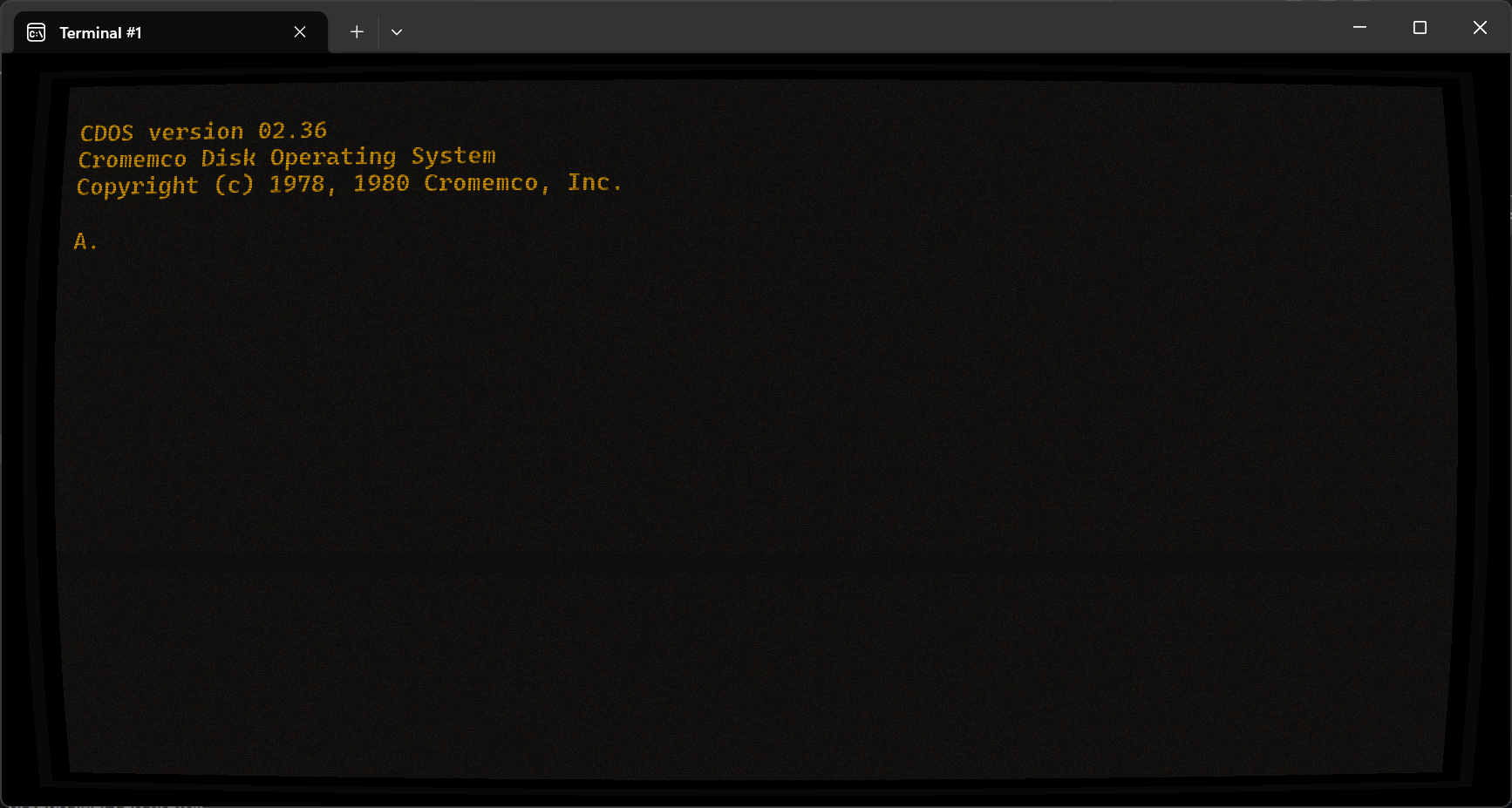
2. Insert the 86-DOS source code disk in drive B.
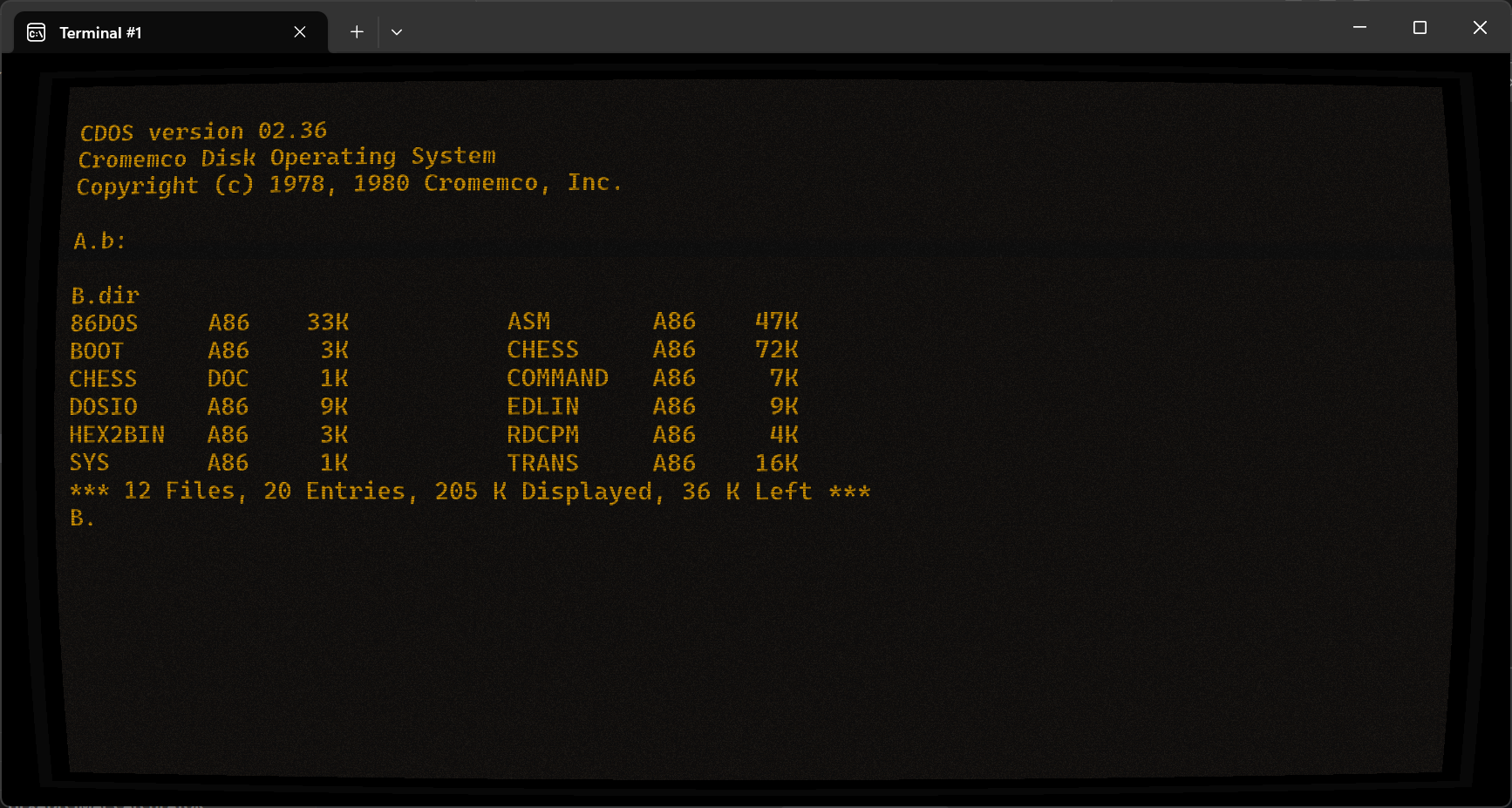
3. Insert a blank formatted 8" SSSD disk in drive C.
4. For each source (.A86) file on drive B:
1. Assemble to .HEX object by running ASM86 \.BCZ.
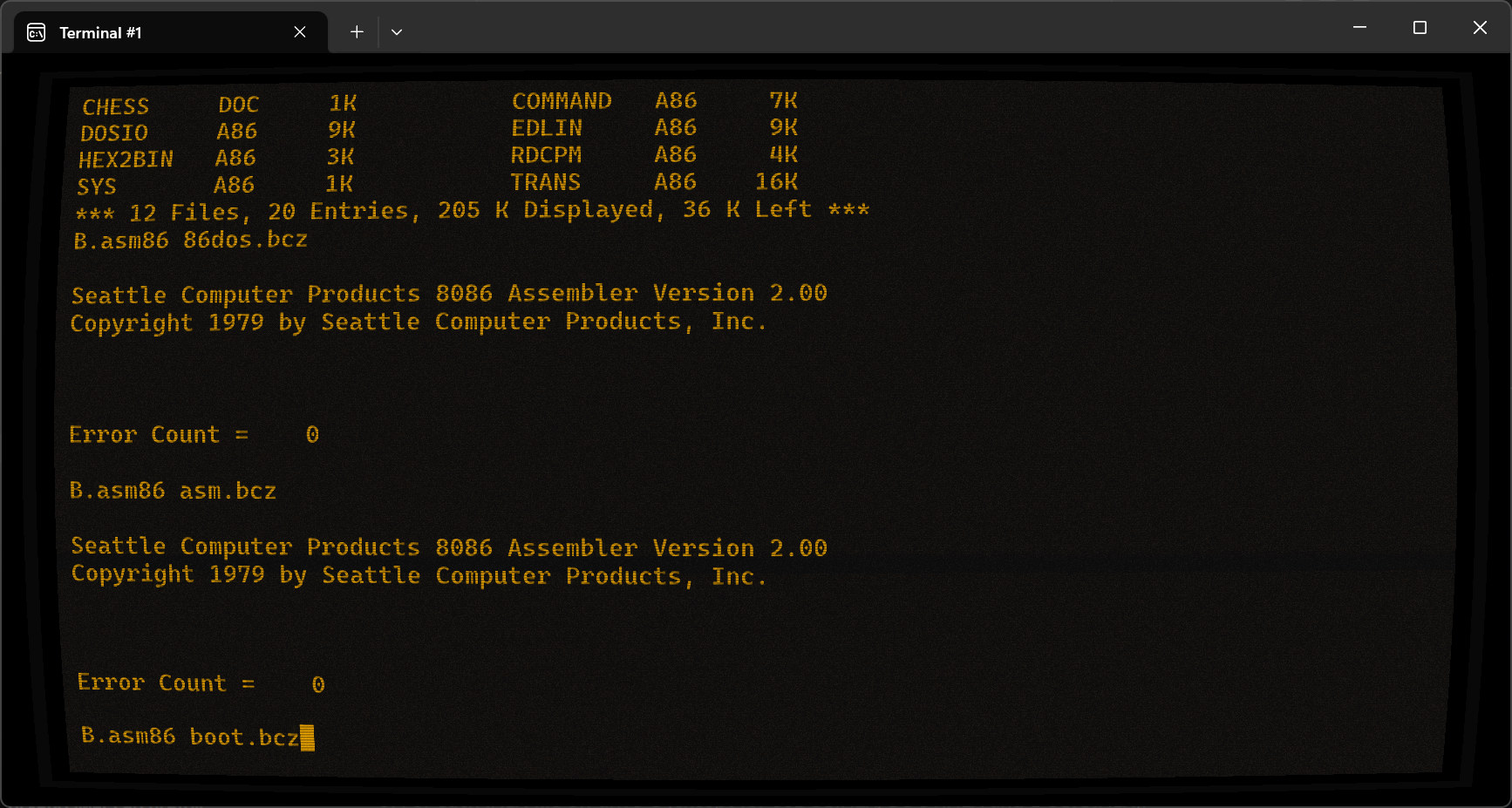
5. Copy CHESS.DOC from drive B to drive C.
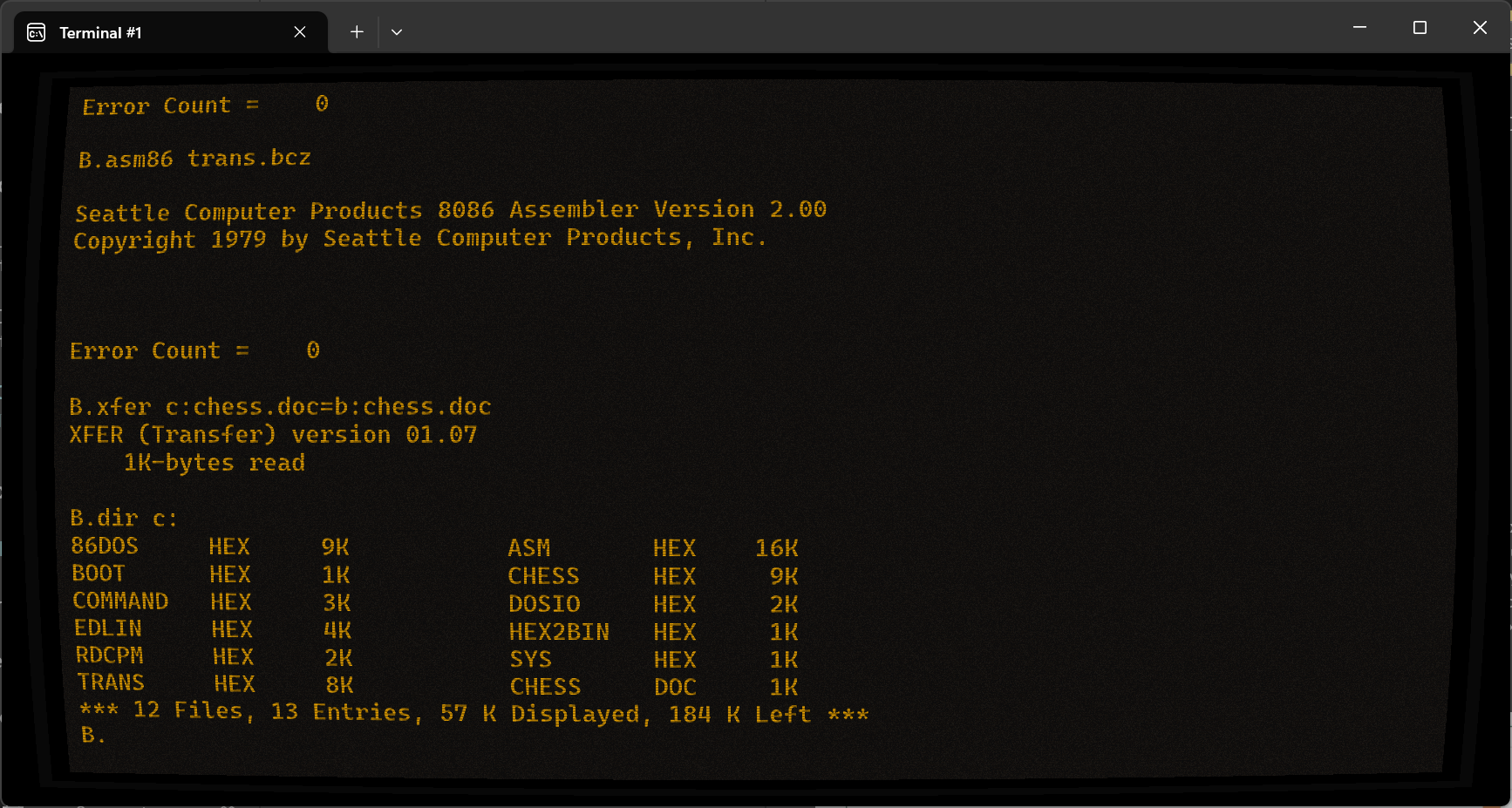
6. Power on the 8086 S-100 machine and boot the earlier version of 86-DOS.
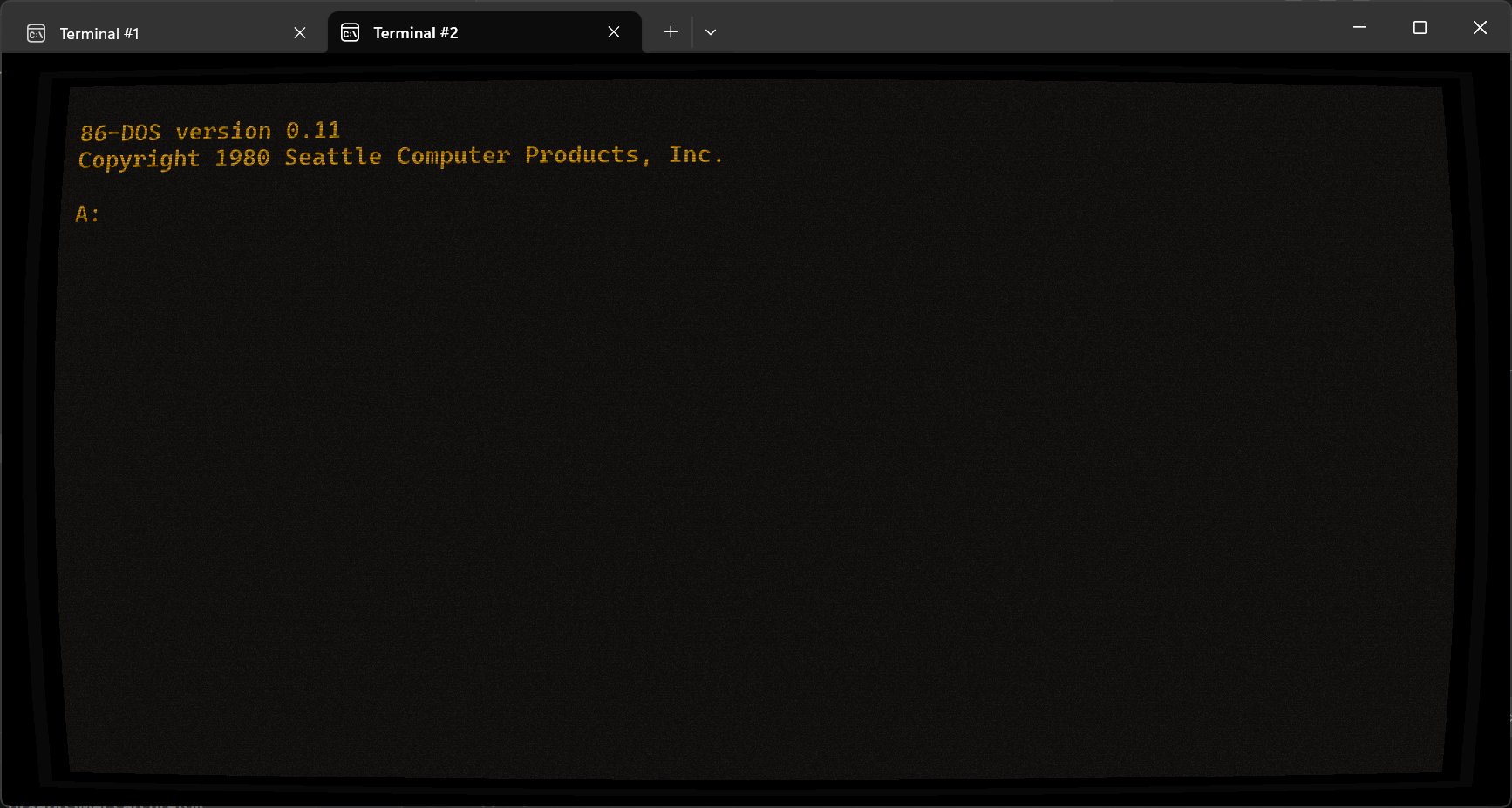
7. Remove the disk in drive C of the Z-2D machine and insert it into drive C of the S-100 machine.
8. Insert a blank formatted 8" SSSD disk into drive B.
9. For each .HEX file on drive C (except for 86DOS.HEX, BOOT.HEX and DOSIO.HEX):
1. Run RDCPM C:\.HEX A:
2. Run HEX2BIN \
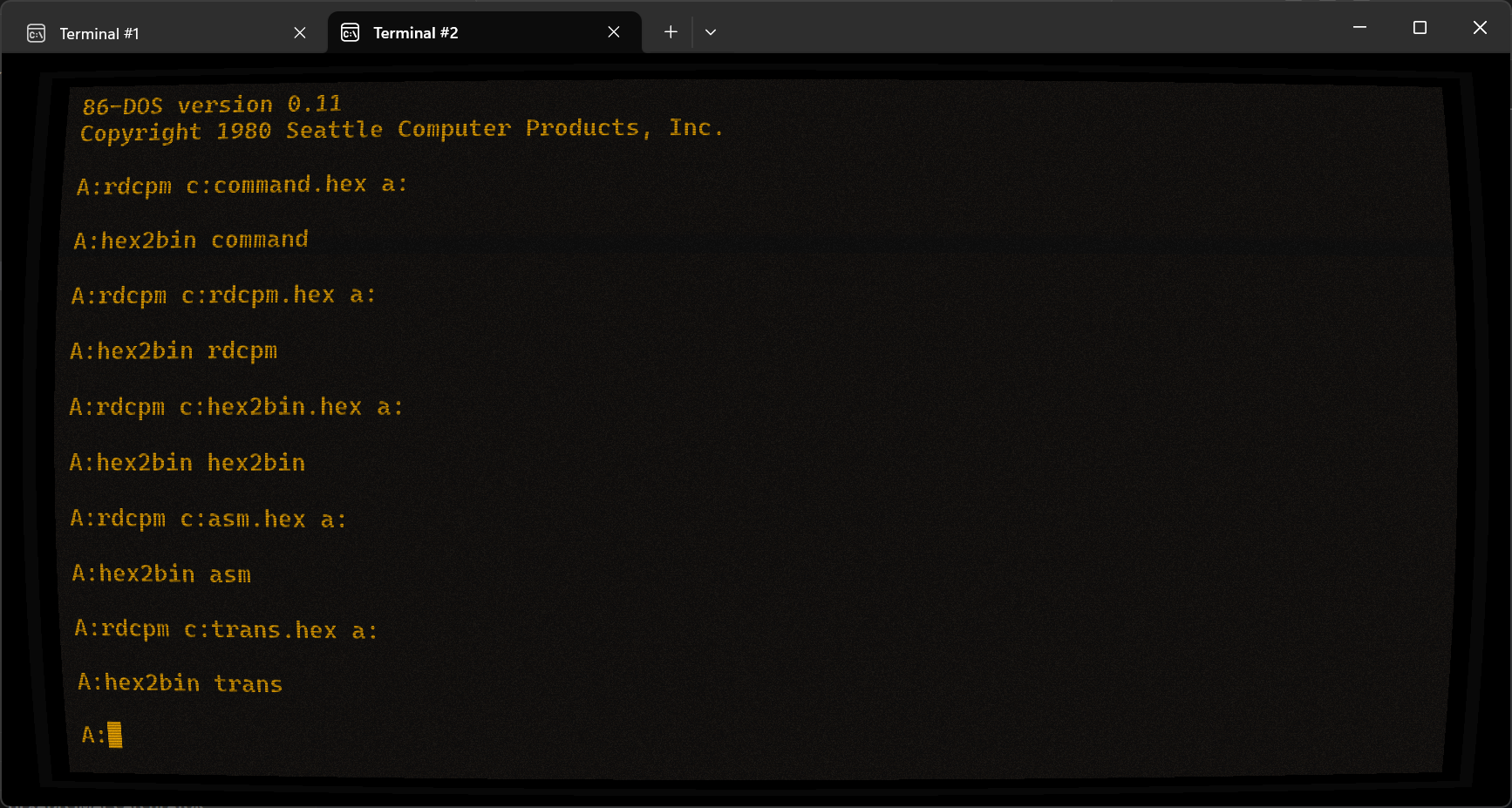
10. Run RDCPM C:CHESS.DOC A:.
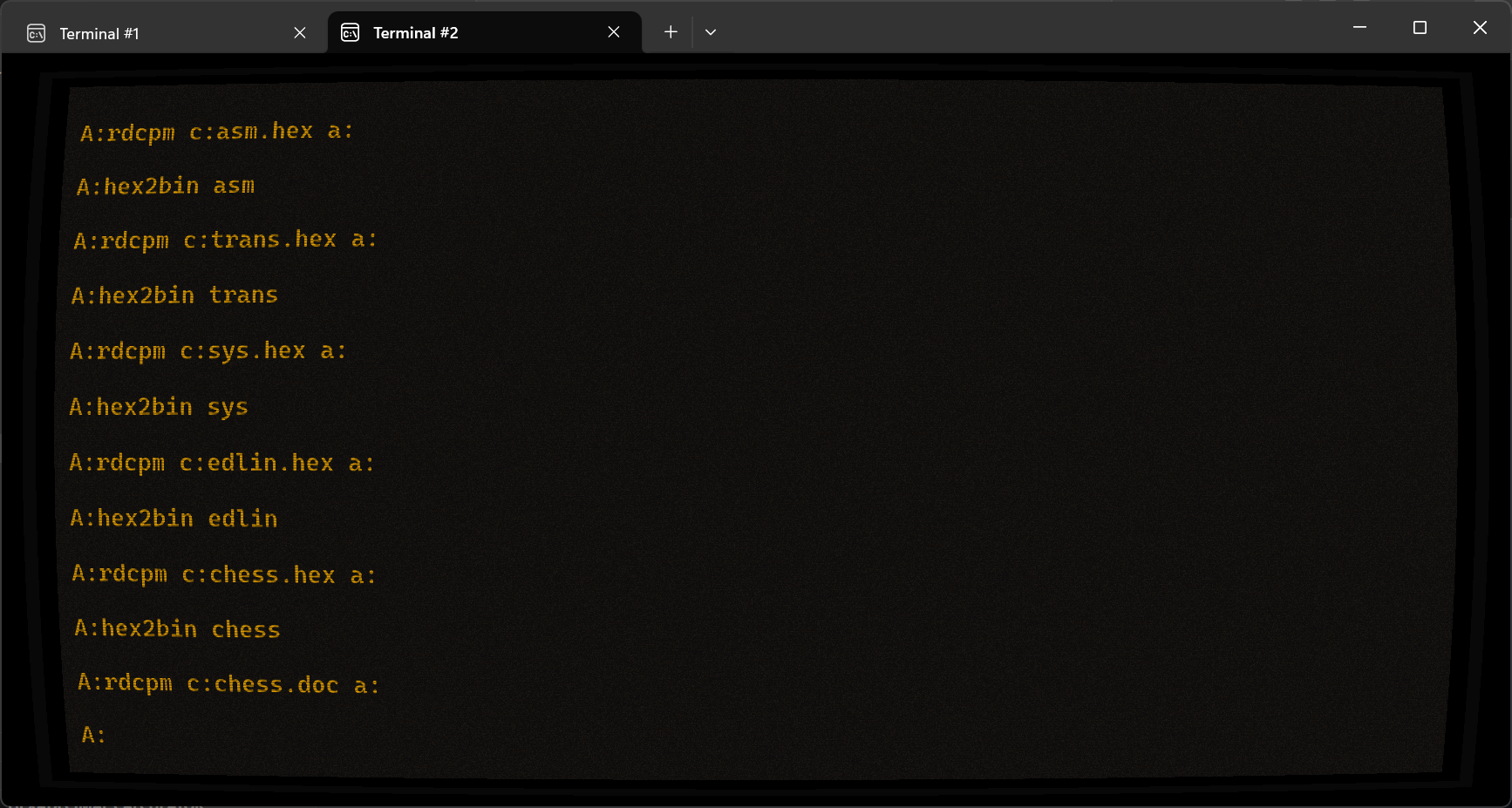
11. Run EDLIN CHESS.DOC and exit with the command E (to remove extra bytes at the end of CHESS.DOC).
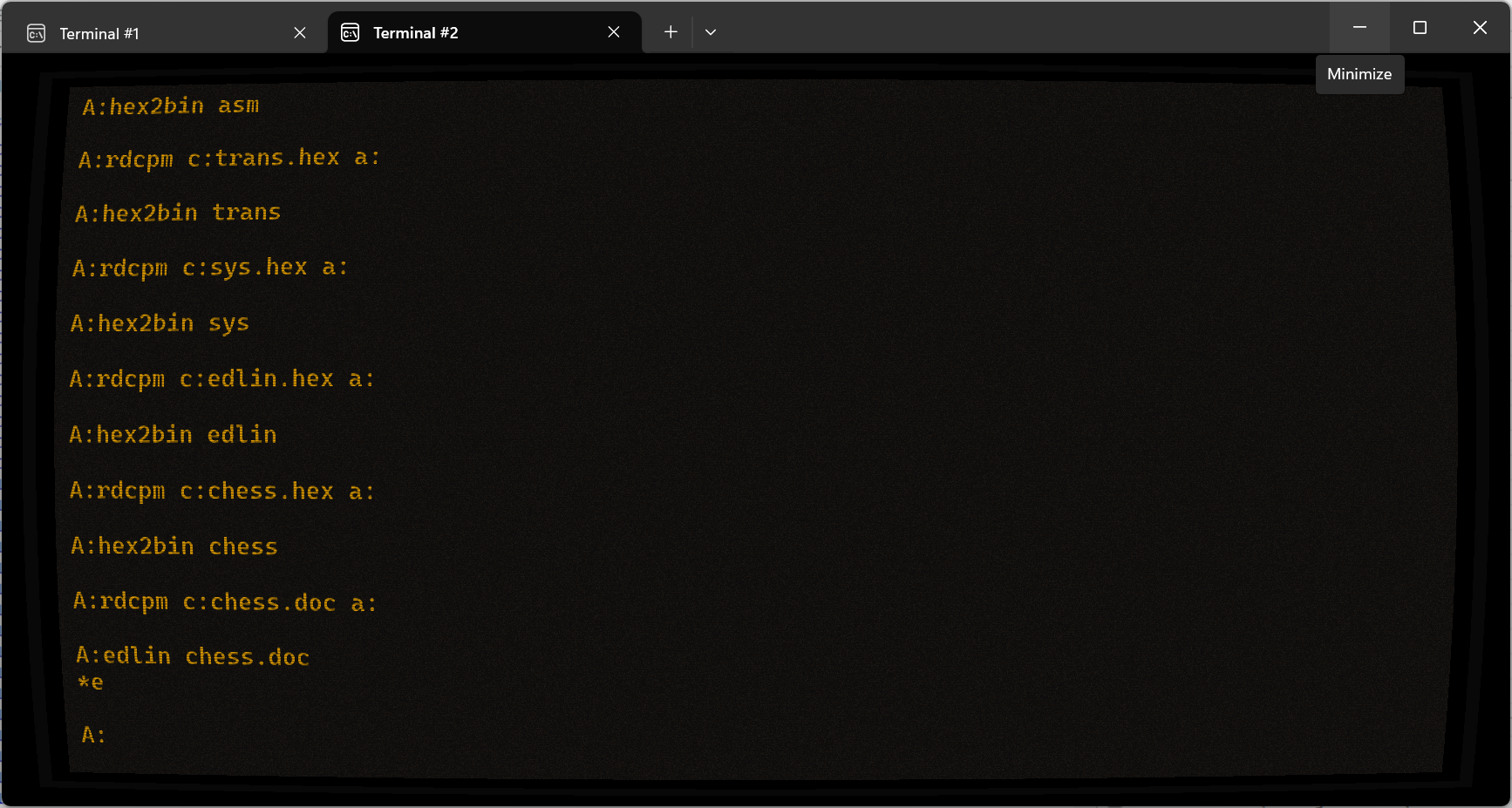
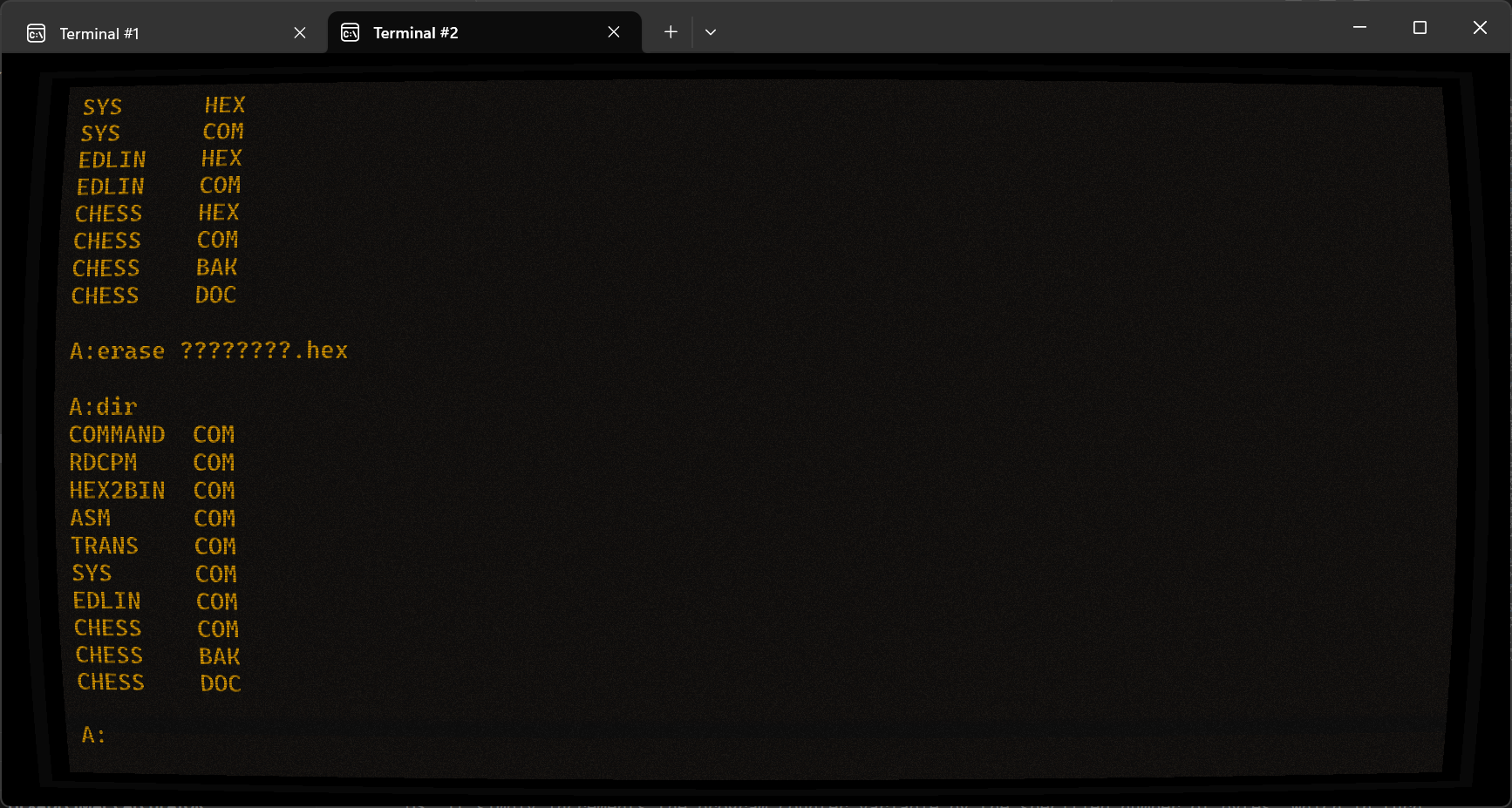
12. Run ERASE ????????.HEX (to delete all .HEX files).
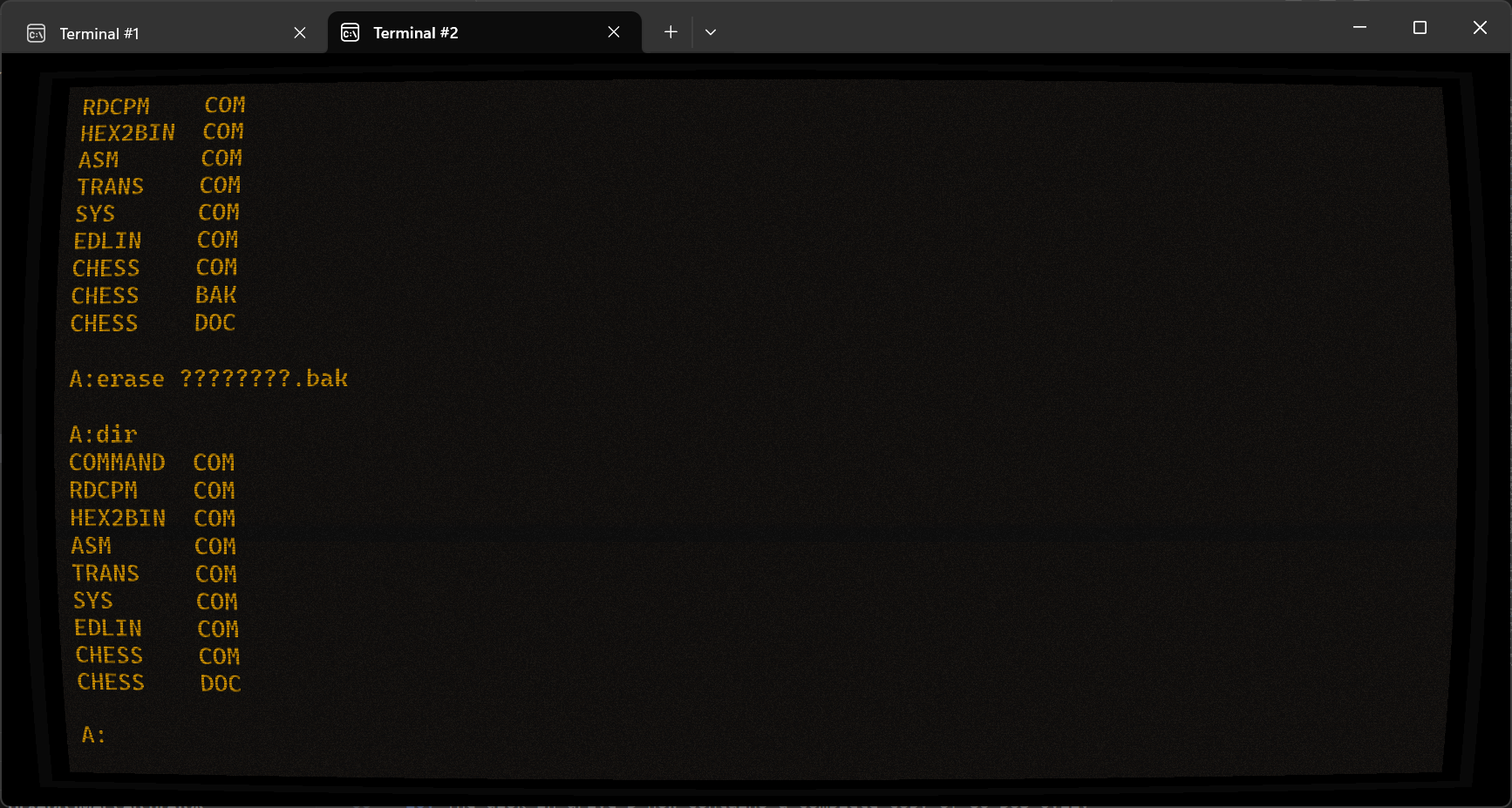
13. Run ERASE ????????.BAK (to delete all .BAK files).
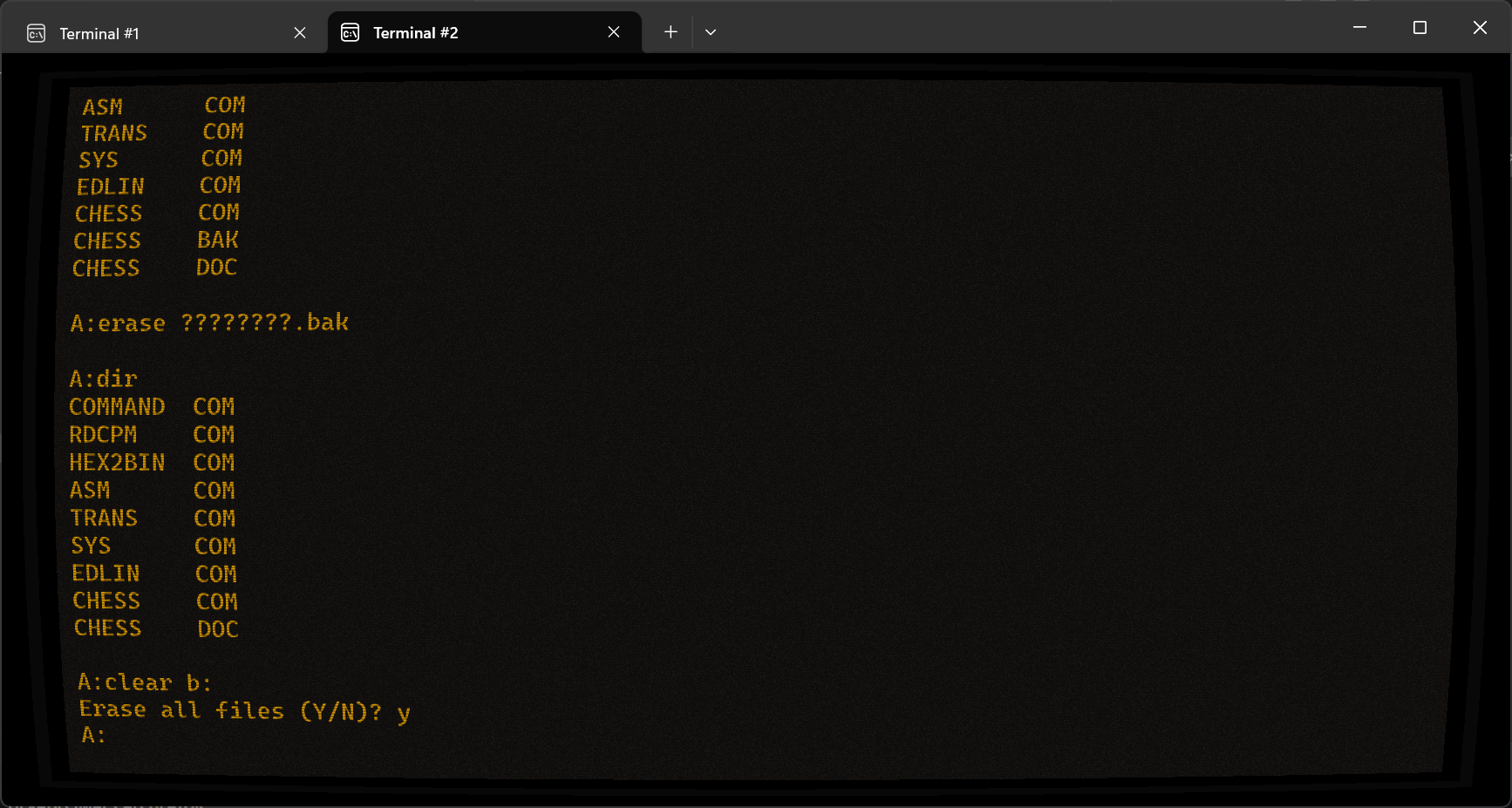
14. Run CLEAR B: and type Y (to put a filesystem on drive B).
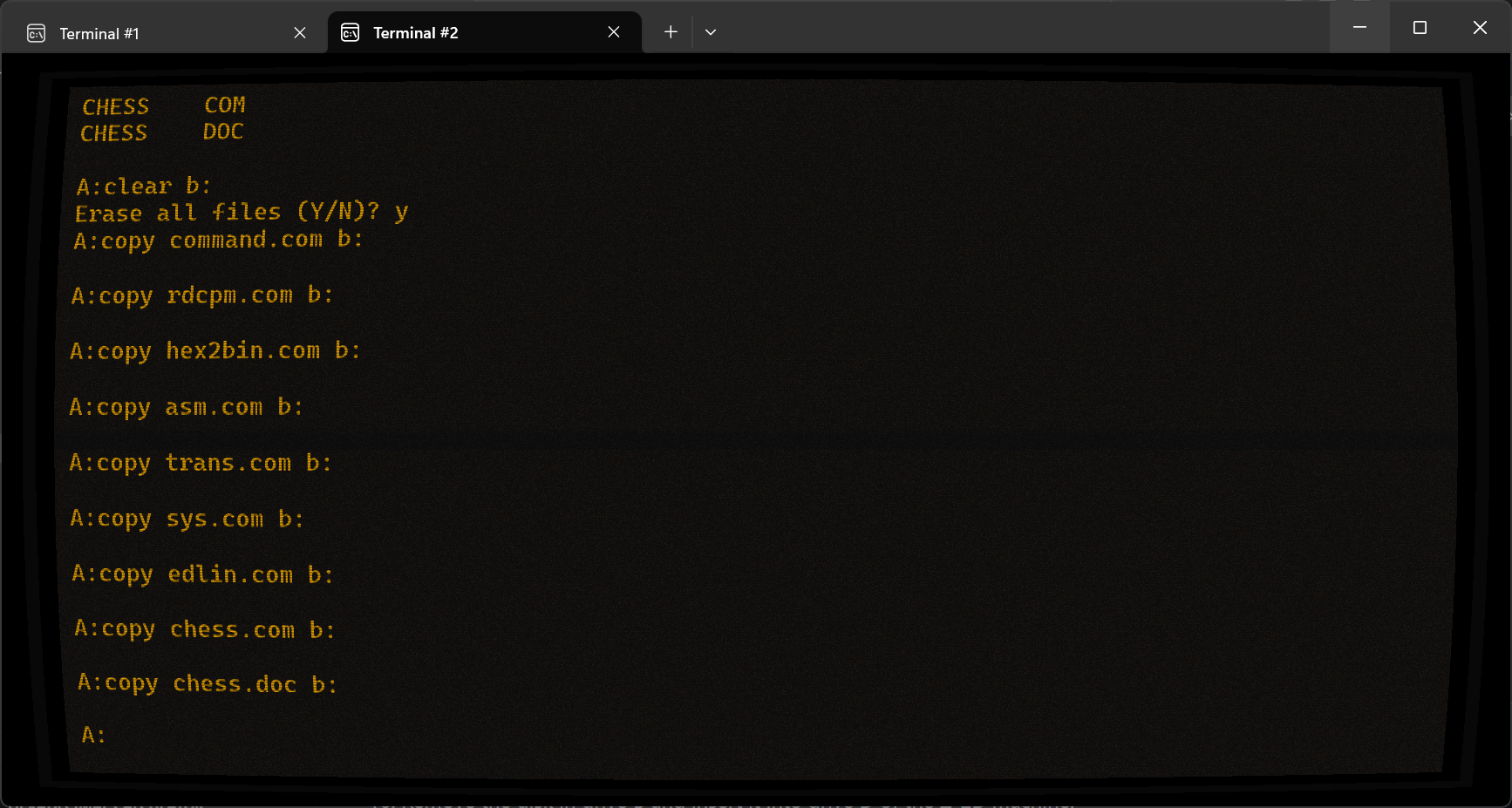
15. Copy all files from drive A to drive B (to create a "fresh" and "clean" disk).
16. Remove the disk in drive B and insert it into drive D of the Z-2D machine.
17. Remove the disk in drive C and insert it into drive C of the Z-2D machine.
18. Go back to the Z-2D machine and change to drive C.
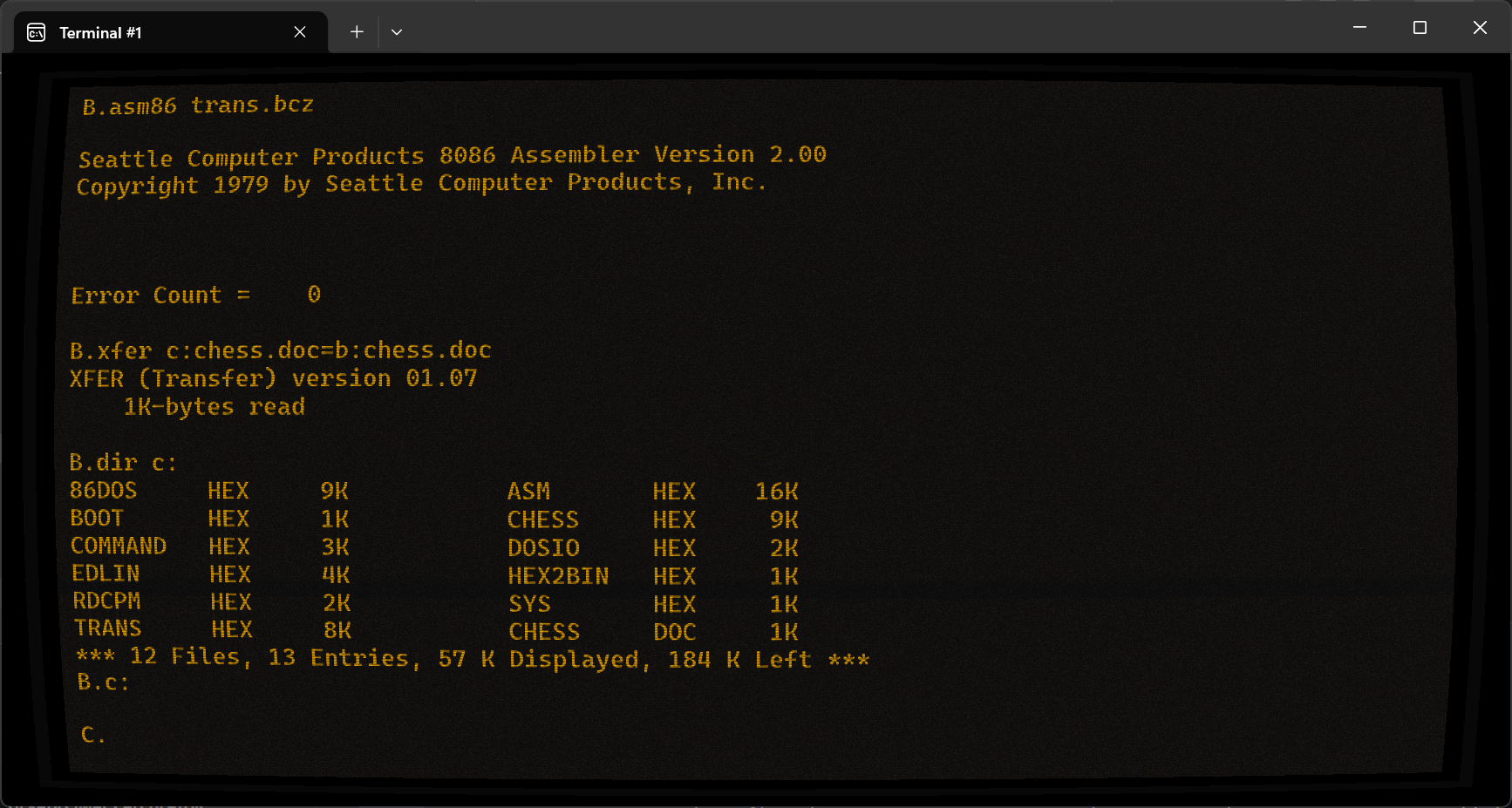
19. For 86DOS, BOOT and DOSIO:
1. Run DEBUG \.HEX.
2. Quit DEBUG and dump the correct number of pages by running SAVE \.COM \. The number of pages is given by ⌈(NEXT - 0x100) ÷ 0x100⌉.
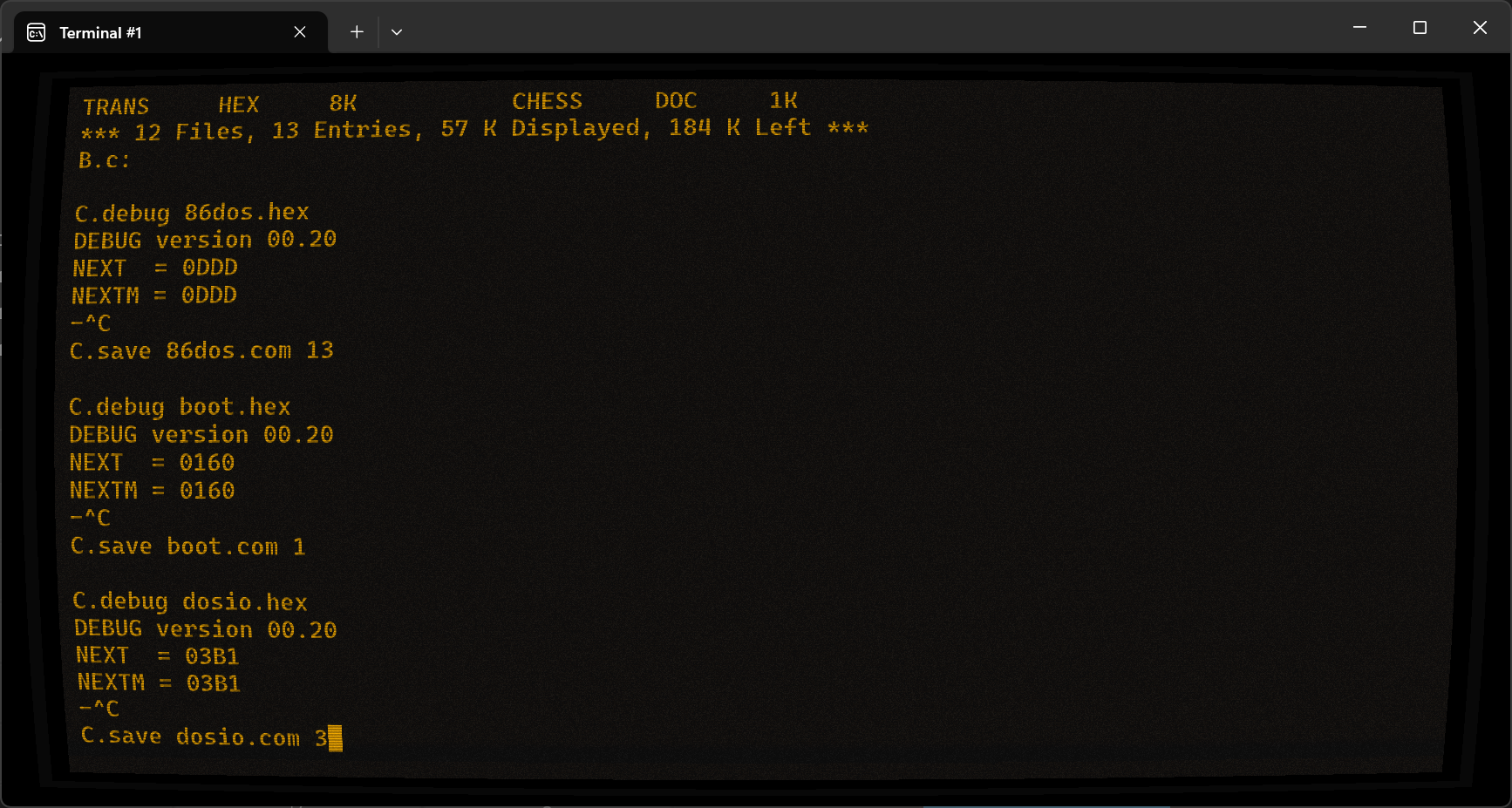
20. Run DOSGEN D:.
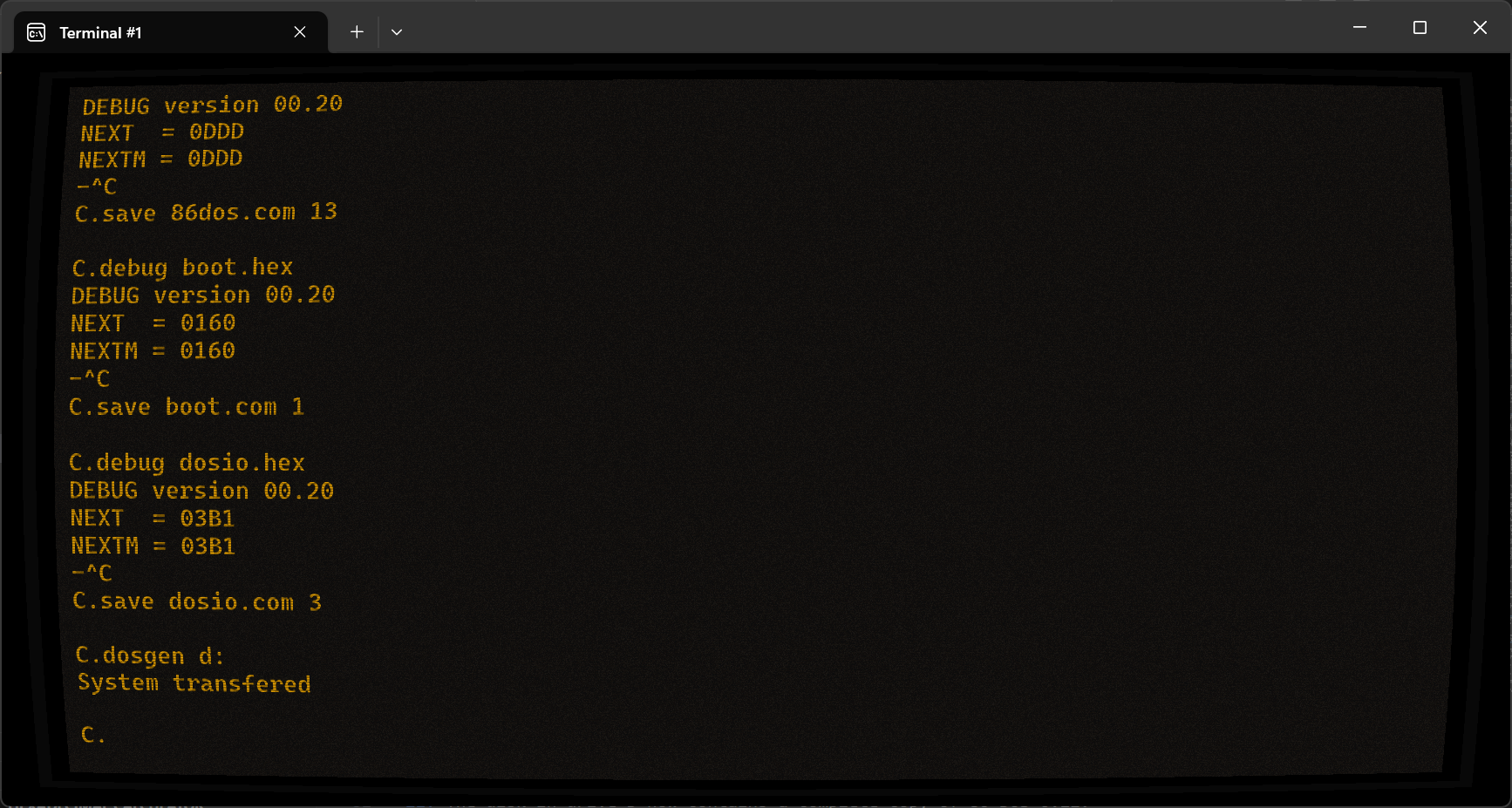
21. The disk in drive D now contains a complete copy of 86-DOS 0.11.
### Source of Details
If you examine the steps above, you'll notice that the disk containing the .HEX files is to be inserted into drive C of the SCP S-100 machine. Clearly, inserting the disk into any drive would work just as well. So, why did I specifically mention drive C? Well, because that's the drive Paterson used. Please refer to [Analysis of Uninitialized Data](#analysis-of-uninitialized-data) for further details.
## The Chicken and Egg Problem
In order to create a working copy of 86-DOS 0.11 from scratch, we need an earlier version of 86-DOS. However, we don't have that. Of course, we could simply use the original 0.11 distribution disk, but then we face a problem: How was that distribution disk made in the first place? Maybe with a copy of 86-DOS 0.10? But then this leads to another question: How was 86-DOS 0.10 built?
You see, to build 86-DOS, you need 86-DOS, and to get 86-DOS, you need to build 86-DOS... so how was the very first copy of 86-DOS built?
### The First Egg
Now, I'll guide you through creating a minimum build of 86-DOS 0.11 without the need of another copy of 86-DOS. I call this the first "egg".
#### Requirements
*Same as [Building 86-DOS 0.11 :: Requirements](#requirements).*
> [!IMPORTANT]
> You will need to make a temporary copy of the source code disk, because you will be modifying DOSIO.A86 to use LARGECRO instead of COMBCRO.
#### Steps
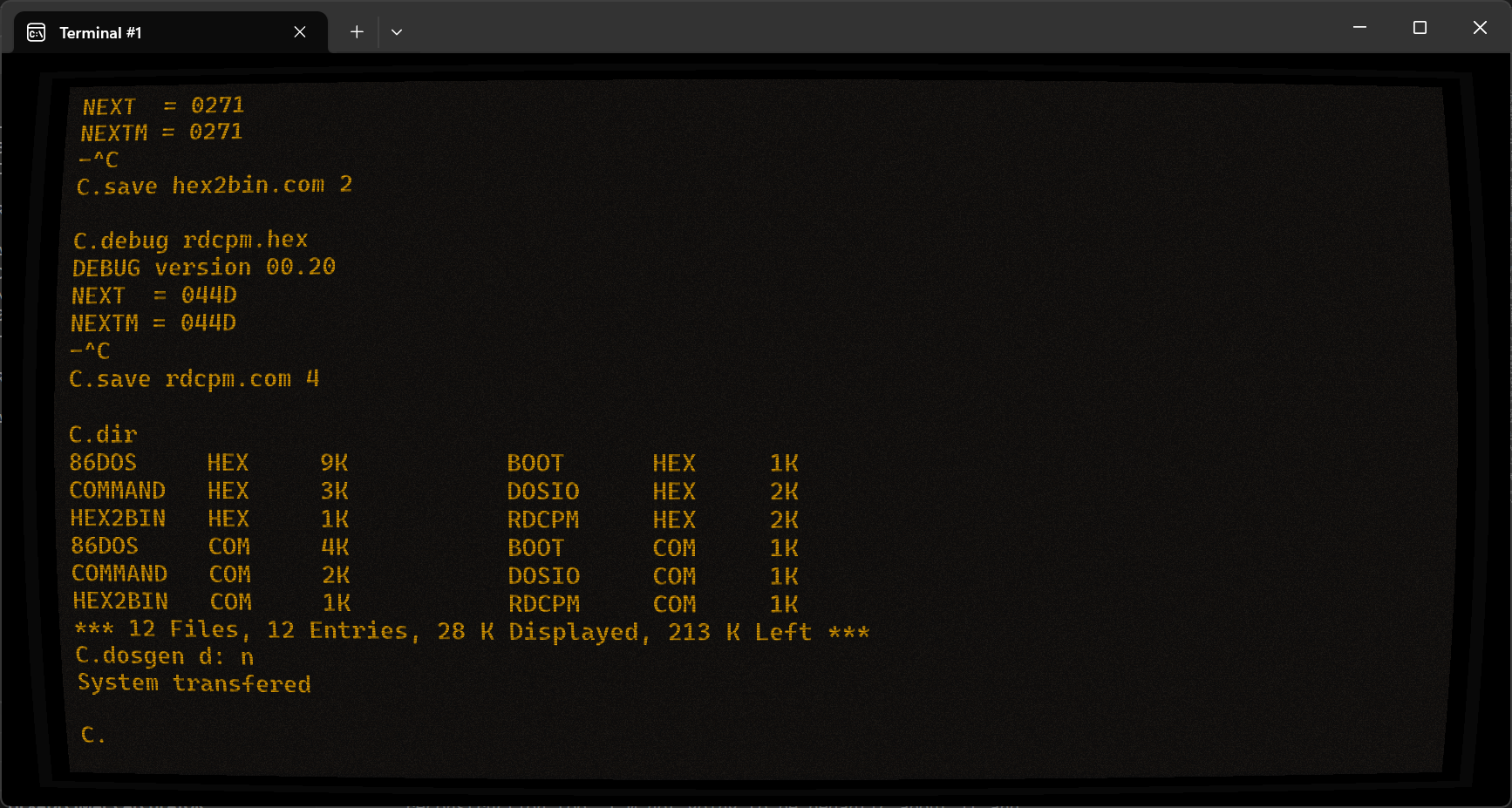
1. Power on the Z-2D machine and boot the CDOS disk.
2. Insert the 86-DOS source code disk (copy) in drive B.
3. Insert a blank formatted 8" SSSD disk in drive C.
4. Change to drive B and edit DOSIO.A86 to use the LARGECRO drive configuration.
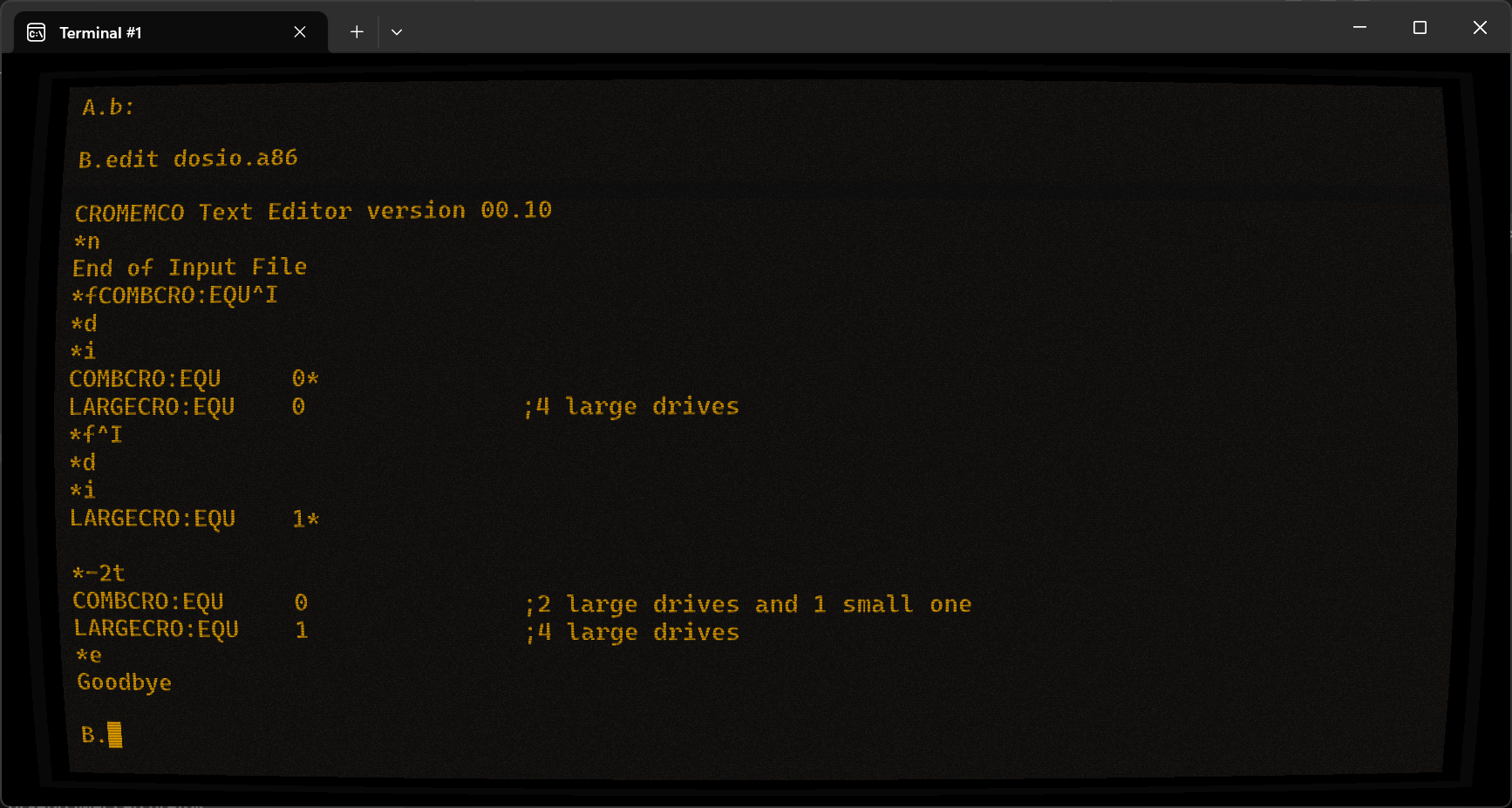
5. For 86DOS, BOOT, COMMAND, DOSIO, HEX2BIN and RDCPM:
1. Assemble to .HEX object by running ASM86 \.BCZ.
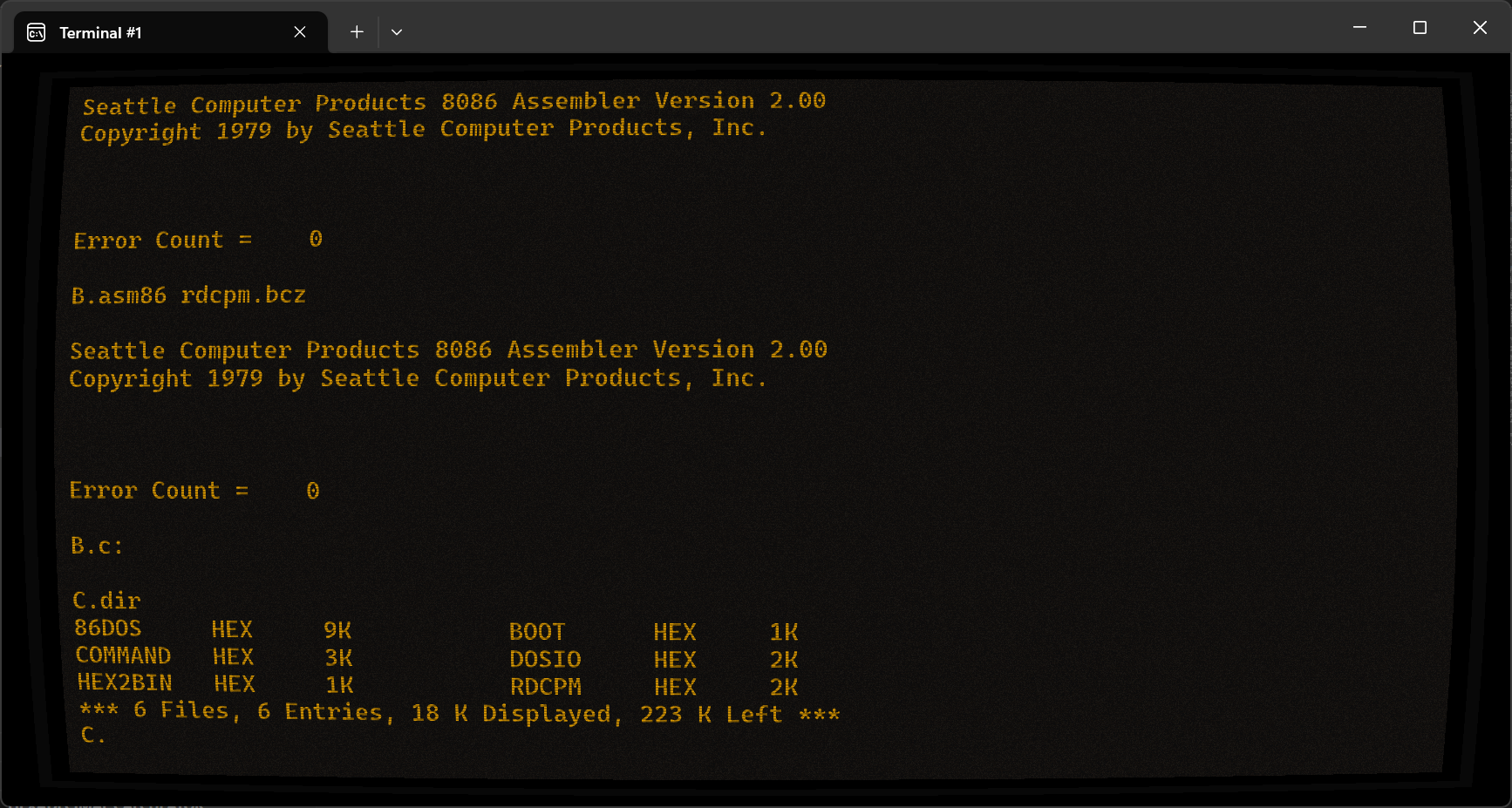
6. Change to drive C and for 86DOS, BOOT, COMMAND, DOSIO, HEX2BIN and RDCPM:
1. Load the .HEX object to memory by running DEBUG \.HEX.
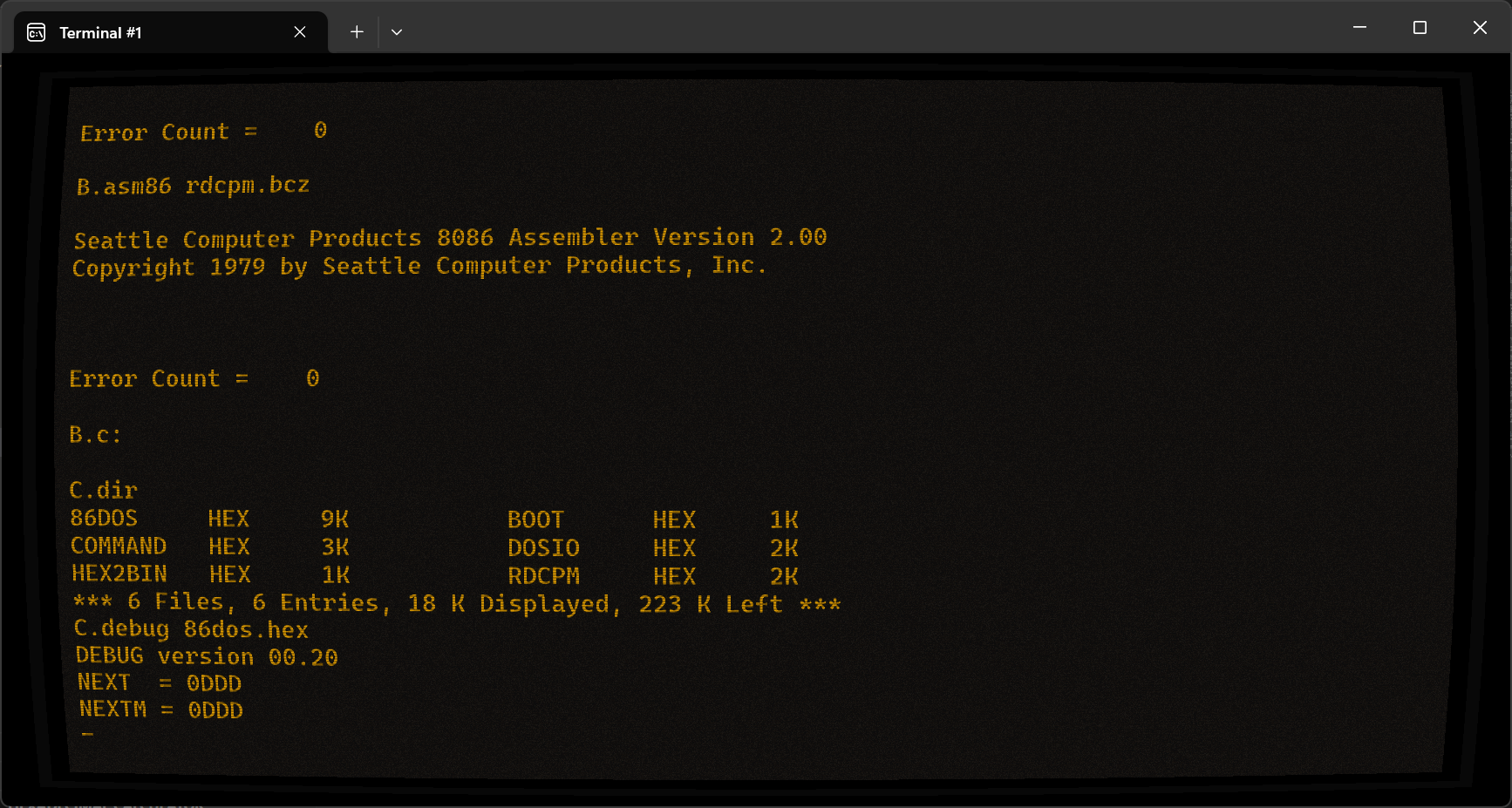
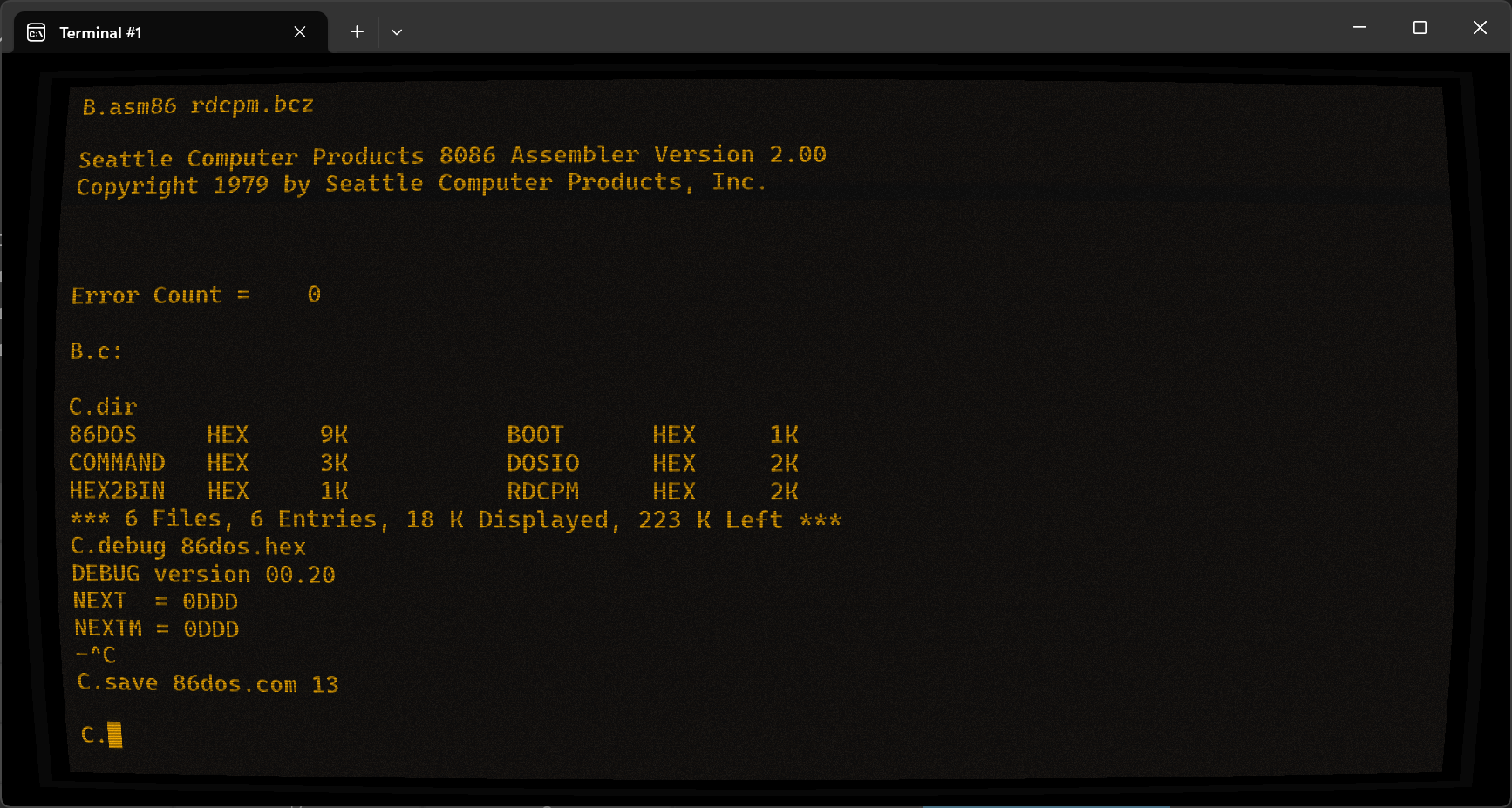
2. Quit DEBUG and dump the correct number of pages by running SAVE \.COM \. The number of pages is given by ⌈(NEXT - 0x100) ÷ 0x100⌉.
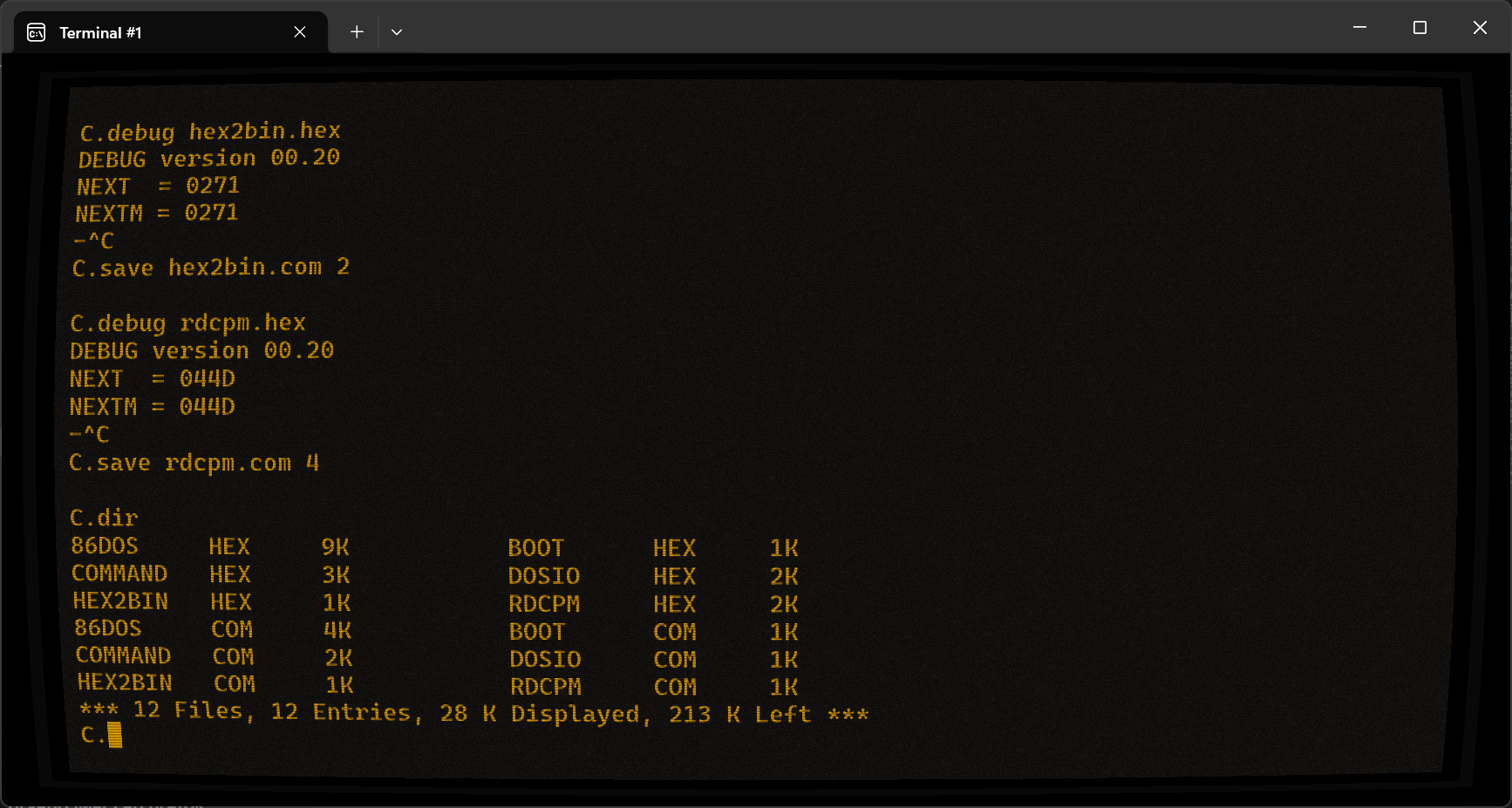
7. Insert a blank formatted 8" SSSD disk into drive D.
8. Run DOSGEN D: N.
9. Pop out the disks in drives C and D, and insert them into drives C and A of the S-100 machine, respectively.
10. Boot up the 8086 S-100 machine.
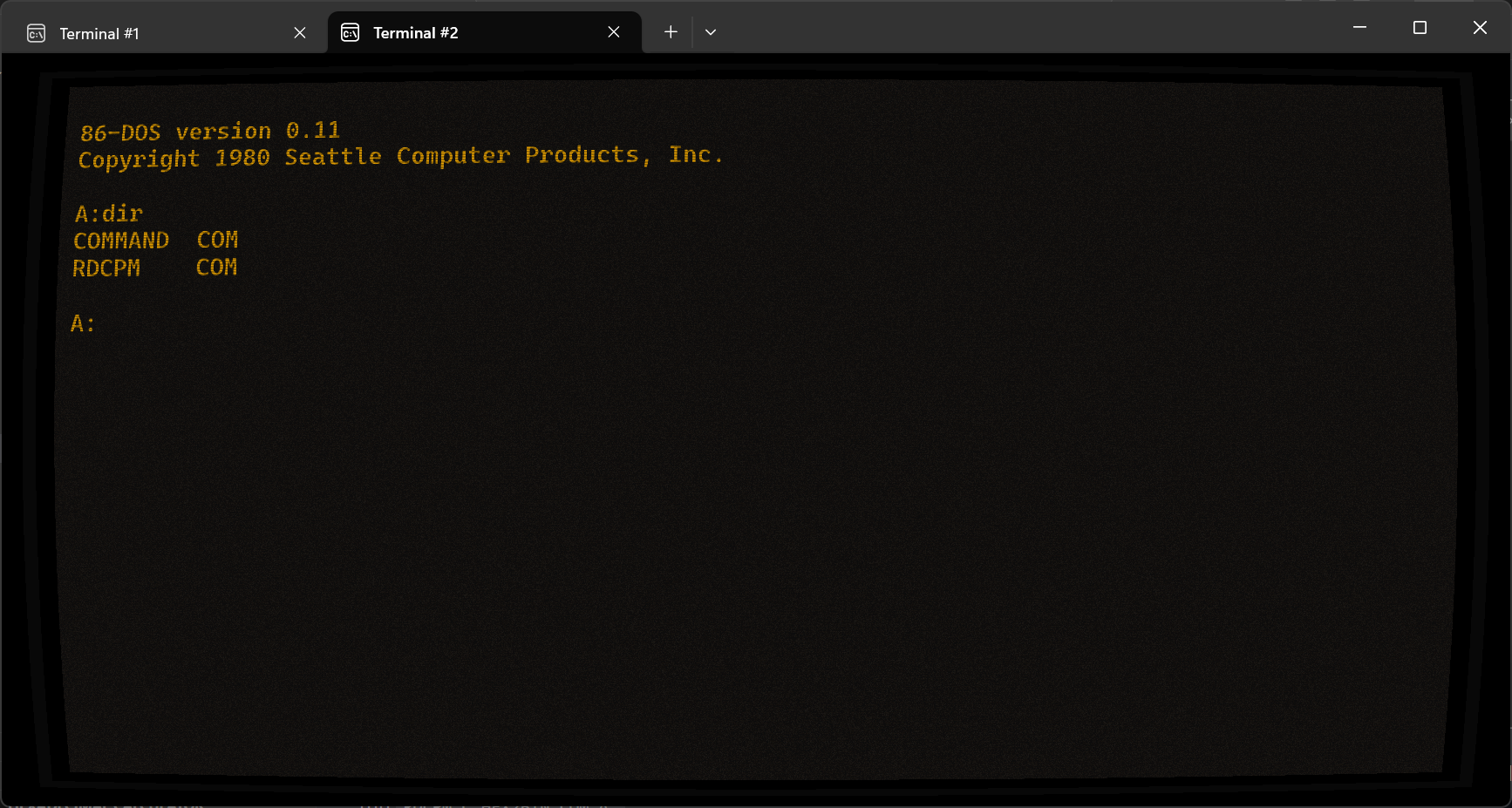
11. Run run RDCPM C:HEX2BIN.COM A: to copy HEX2BIN.COM over.
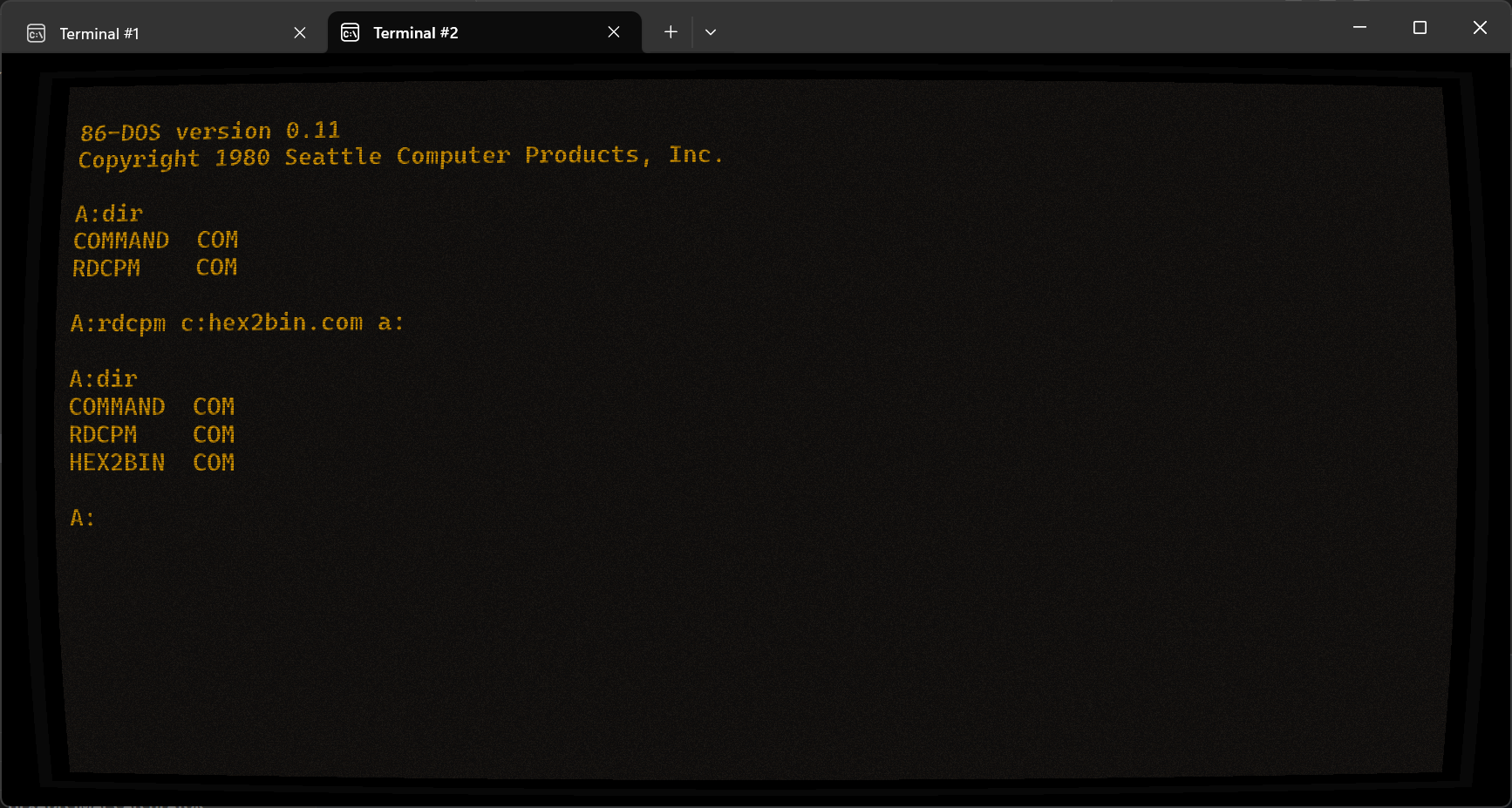
12. The disk in drive A now contains a minimal build of 86-DOS 0.11, which can be used to facilitate the building of a complete copy of 86-DOS 0.11.
## Analysis of Uninitialized Data
### What is Uninitalized Data
SCP's 8086 assembler (hereinafter referred to as ASM86) supports a DS (Define Storage) pseudo-op, similar to MASM's DB n DUP(?). Since ASM86 generates Intel HEX files, when it encounters a DS, it increments the program counter variable by the specified number of bytes, which, in turn, increases the address in the .HEX file. The same goes for specifying a custom put base, which literally tells the assembler to emit code at a specified address.
When a .HEX file is loaded, the parser reads it line by line and copies the data to the address specified at the beginning of each line. This means that if there is a gap between the addresses of two lines, which would be the case when the put base is incremented by DS or PUT, the data inside the gap will be uninitialized and, therefore, undefined.
Suppose that I originally have this data at address 0x100:
```
Offset(h) 00 01 02 03 04 05 06 07 08 09 0A 0B 0C 0D 0E 0F
00000100 54 68 69 73 20 66 69 6C 65 20 63 6F 6E 74 61 69 This file contai
00000110 6E 73 20 6D 79 20 70 61 73 73 77 6F 72 64 2E 20 ns my password.
00000120 4D 79 20 70 61 73 73 77 6F 72 64 20 69 73 20 61 My password is a
00000130 62 63 31 32 33 2E 20 44 6F 20 6E 6F 74 20 6C 65 bc123. Do not le
00000140 61 6B 20 74 68 69 73 21 ak this!
```
Now, I load this Intel HEX file (notice the gap of 18 bytes between the second and third line):
```
Len Addr Type Data Hash
: 1A 0100 00 2CC3EB8233940FDC4C1C9507C82F8C88237F9602D154EC95F3C6 2F
: 09 011A 00 041CA1DC8862B224C9 B6
: 13 0135 00 74CFDA5478D2CCA5C79A6D8BD6CB32629EDE90 F1
```
The memory then becomes this:
```
Offset(h) 00 01 02 03 04 05 06 07 08 09 0A 0B 0C 0D 0E 0F
00000100 2C C3 EB 82 33 94 0F DC 4C 1C 95 07 C8 2F 8C 88 ,Ãë‚3”.ÜL.•.È/Œˆ
00000110 23 7F 96 02 D1 54 EC 95 F3 C6 04 1C A1 DC 88 62 #.–.ÑTì•óÆ..¡Üˆb
00000120 B2 24 C9 70 61 73 73 77 6F 72 64 20 69 73 20 61 ²$Épassword is a
00000130 62 63 31 32 33 74 CF DA 54 78 D2 CC A5 C7 9A 6D bc123tÏÚTxÒ̥ǚm
00000140 8B D6 CB 32 62 9E DE 90 ‹ÖË2bžÞ.
```
The 18-byte buffer at offset 0x123 is what we call uninitialized data, which in this case, happens to contain the leftover string password is abc123.
#### Case Study: CHESS.COM
Let's take a look at this fragment of uninitialized data at offset 0x64 of CHESS.COM. It's only 156 bytes, but you will be surprised by the amount of information that can be inferred from these bits.
```
Offset(h) 00 01 02 03 04 05 06 07 08 09 0A 0B 0C 0D 0E 0F
00000060 69 6C 65 20 6E 61 6D 65 0D 0A 24 02 ile name..$.
00000070 01 43 48 45 53 53 20 20 20 48 45 58 00 00 B9 03 .CHESS HEX..¹.
00000080 01 60 E4 0E 66 00 77 00 48 00 11 00 FF FF EB D4 .`ä.f.w.H...ÿÿëÔ
00000090 48 00 50 52 49 4C 53 54 44 4C 20 20 20 00 00 00 H.PRILSTDL ...
000000A0 09 25 29 00 00 00 00 00 00 00 00 00 00 00 00 00 .%).............
000000B0 00 00 53 55 50 43 48 45 53 53 48 45 58 00 00 00 ..SUPCHESSHEX...
000000C0 47 7E 7F 81 82 83 84 85 86 87 00 00 00 00 00 00 G~..‚ƒ„…†‡......
000000D0 00 00 53 55 50 43 48 45 53 53 43 4F 4D 00 00 00 ..SUPCHESSCOM...
000000E0 32 88 89 8A 8B 8C 8D 8E 00 00 00 00 00 00 00 00 2ˆ‰Š‹Œ.Ž........
000000F0 00 00 44 41 4E 20 20 20 20 20 20 20 20 00 00 00 ..DAN ...
```
What we first see is a string ile name\r\n$. If we examin RDCPM.COM, we will see that it has the exact same string at offset 0x1D5. So, we are probably looking at a partial memory dump of RDCPM. There is a 1-byte size difference between that copy of RDCPM.COM and 86-DOS 0.11's RDCPM.COM, because the string ends at offset 0xE of that paragraph instead of 0xF. Since we have identified the origin of the data, we can take a look at the RDCPM source code to determine the meaning of the rest of the data.
```x86asm
BADFN: DB 13,10,"Bad file name",13,10,"$"
DRIVE: DS 1
DSTFCB: DS 32
DB 0
DIRBUF: DS 128
```
The byte at 0x6F is the DRIVE variable, which holds the drive ID of the CP/M disk. A value of 0x02 signifies drive C. Next comes DSTFCB, the FCB of the destination file. We can see from the first 12 bytes that it's the file A:CHESS.HEX. This gives us the RDCPM command line RDCPM C:CHESS.HEX A:.
If we look further at DSTFCB, we will notice that it does not actually match up with the FCB format of 86-DOS 0.11. This strongly suggests that RDCPM was run under an earlier version of 86-DOS.
After the FCB, we have DIRBUF, which holds a directory sector of the CP/M disk. We can decode it:
| Filename | Size | Blocks | Block List |
| - | - | - | - |
| PRILSTDL | 1152 | 2 | 37, 41 |
| SUPCHESS.HEX | 9088 | 9 | 126, 127, 129, 130, 131, 132, 133, 134, 135 |
| SUPCHESS.COM | 6400 | 7 | 136, 137, 138, 139, 140, 141, 142 |
| DAN | ? | ? | ? |
I have no idea what PRILSTDL was; if I had to guess, it probably had something to do with the printing of assembly language listings. SUPCHESS.HEX had the exact same size as the .HEX file for 86-DOS 0.11's CHESS program, and SUPCHESS.COM had the same size as CHESS.COM, so SUPCHESS thing was just CHESS. I doubt anyone will ever be able figure out what DAN was.
The most crucial information we can infer from this directory fragment is the format of the CP/M disk in drive C. RDCPM only ever supported 2 CP/M disk formats out of the box - the standard 8" SSSD format with a sector skew of 6, and the 5" Cromemco format with a sector skew of 5. The largest block number for the 5" format is about 82, so based on this alone, we can deduce that this directory fragment belonged to an 8" disk.
##### Summary (TL;DR)
1. The file CHESS.HEX file was converted to CHESS.COM under 86-DOS.
2. RDCPM was used to copy CHESS.HEX from a CP/M disk.
3. The RDCPM command was RDCPM C:CHESS.HEX A:.
4. The disk in drive C was a standard 8" SSSD CP/M disk.
1. Given that drive C was 8", the drive configuration was LARGECRO.
#### Case Study: SYS.COM
SYS.COM also has some uninitialized data, this time only a partial directory sector.
```
Offset(h) 00 01 02 03 04 05 06 07 08 09 0A 0B 0C 0D 0E 0F
00000090 20 41 38 36 00 00 00 A86...
000000A0 2B 4C 4D 5C 68 69 6A 00 00 00 00 00 00 00 00 00 +LM\hij.........
000000B0 00 00 53 59 53 20 20 20 20 20 48 45 58 00 00 00 ..SYS HEX...
000000C0 04 23 00 00 00 00 00 00 00 00 00 00 00 00 00 00 .#..............
000000D0 00 00 53 59 53 20 20 20 20 20 42 41 4B 00 00 00 ..SYS BAK...
000000E0 05 26 00 00 00 00 00 00 00 00 00 00 00 00 00 00 .&..............
000000F0 00 00 43 4F 4D 4D 41 4E 44 20 48 45 58 00 00 00 ..COMMAND HEX...
```
| Filename | Size | Blocks | Block List |
| - | - | - | - |
| ?.A86 | 5504 | 6 | 76, 77, 92, 104, 105, 106 |
| SYS.HEX | 512 | 1 | 35 |
| SYS.BAK | 640 | 1 | 38 |
| COMMAND.HEX | ? | ? | ? |
There's nothing particularly interesting here, but SYS.BAK (presumably produced by editing SYS.A86 with EDIT) had the exact same size as my reconstructed SYS.A86, so my SYS disassembly can't be too far off the original. I'm not sure what that .A86 file was, but my educated guess is it was COMMAND.A86.
#### File Sizes and RDCPM
The size of files copied off CP/M disks should always be multiples of the block size of the CP/M disk, because RDCPM completely ignores the record count and uses only the block pointers to determine when to stop reading. For instance, if the record size is 1K and the file size is 128, when transferred to a DOS disk with RDCPM, it will be 1024 bytes long.
Since none of the files on the original 86-DOS 0.11 distribution disk are exact multiples of 1K, none of them were directly transferred from CP/M disks. This implies that all the .COM binaries were generated by HEX2BIN from .HEX files copied off CP/M disks. CHESS.DOC was either created from scratch under 86-DOS, or transferred from a CP/M disk and then edited by EDLIN under 86-DOS.